
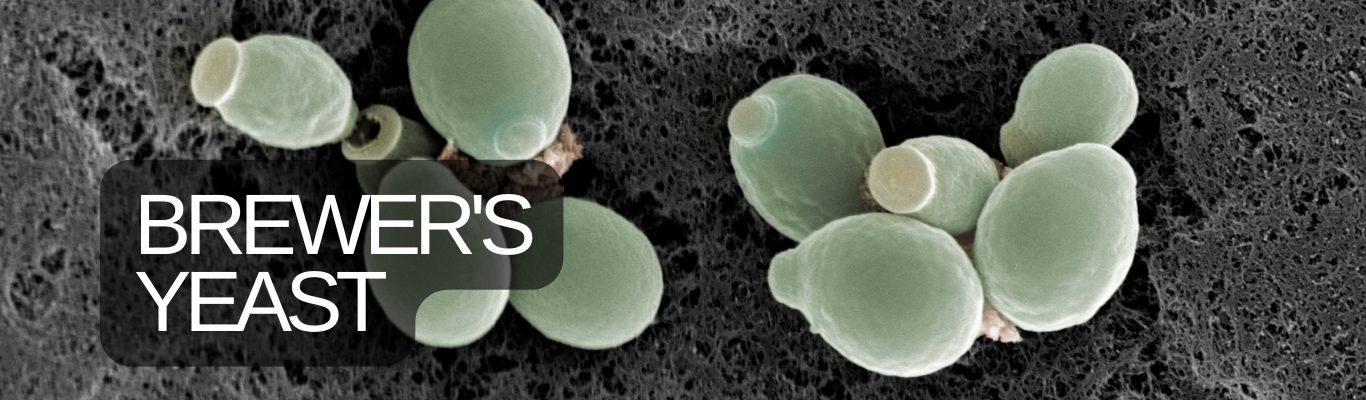
We supply yeast in four forms:
I. Slanted agar
A well-established microbiological laboratory and propagation station are essential for application in operating conditions.
Storage and transport conditions: if the tubes containing the yeast culture are stored in a cool place (1-4 °C), their shelf life is approximately 3 months. After this period, they must be re-inoculated.
During transport, extra care must be taken due to the fragility of the glass tubes (risk of breakage) and the need to monitor the temperature, which should not exceed 20 °C for long periods. Transport time should be minimized (max. 24 hours).
Delivery date
The relevant yeast strain must be ordered at least 2 weeks before the delivery date.
Any yeast strain can be prepared based on the customer’s request.
II. Fermented wort
For application in operation, it requires a well-established propagation station (no microbiological laboratory is necessary). Due to the demanding storage and transport conditions, we offer this form of delivery primarily to domestic customers.
The storage and transport conditions: for this form of yeast culture delivery are very demanding. The temperature must be maintained between 3 and 5 °C, and the shelf life is only a few hours.
Transport is more difficult because it is a liquid medium stored in a plastic barrel. Transport requirements must also be taken into account.
Delivery date
Fermented wort must be ordered at least 3 weeks before the delivery date. The collection date must be set precisely for a specific day; late collection of fermented wort is not possible (see storage conditions). The price of fermented wort is charged even if it has not been collected.
III. Pressed yeast strain RIBM95 (Lager Yeast)
We weigh out any amount of pressed yeast (30% dry matter) according to customer requirements. Dosage – 1.5 g per 1 liter.
Storage and transport conditions: if it is not possible to use the yeast immediately after delivery, it can be stored in a refrigerator at a temperature of 2–5 °C for up to seven days. Transport must be arranged within 72 hours. After that, the yeast must be stored in a refrigerator.
Delivery date: The RIBM95 yeast strain must be ordered at least two weeks before the delivery date for individual deliveries. The yeast strain is delivered in a 100 ml vial.
IV. Lyophilized yeast / RIBM 191, 192, 193, 194, 198
reeze-dried yeast. Sublimation of frozen water at low pressure and temperature. Gentler on microorganisms sensitive to higher temperatures.
Dosage – 1.5 g per 10 liters.
Suitable for the production of: special top-fermented beers, beers with fruit and spice aromas, natural ciders, etc. Saccharomyces cerevisiae strains isolated from the spontaneous fermentation of grape must.
Higher alcohol tolerance, low diacetyl production.
Higher fermentation rate, apparent fermentation 67–70%.
Fermentation in the temperature range of 12–22°C, optimum 18–22°C.
Selection of yeast strains
Agar / Fermentation wort
Andrea Švejdová
svejdova@beerresearch.cz
Old Czech Lager Yeast (RIBM 2)
A traditional Czech yeast strain, with deep fermentation,
and good sedimentation. Suitable for fermentation at low temperatures.
It is characterized by lower production of esters, higher alcohols, and vicinal diketones.
Fermentation: 80%
Sedimentation: medium to high
Optimal fermentation temperature: 8–12 °C
Alcohol tolerance: medium
Beer type: Czech lager
Old Czech Lager Yeast (RIBM 6)
A traditional Czech yeast strain, with deep fermentation,
and good sedimentation. Suitable for fermentation at low temperatures.
It is characterized by lower production of esters, higher alcohols, and vicinal diketones.
Fermentation: 80%
Sedimentation: medium to high
Optimal fermentation temperature: 8–12 °C
Alcohol tolerance: medium
Beer type: lager
California Ale Yeast (RIBM 139) / Ale
A strain suitable for brewing any type of ale.
Produces beers with a pronounced hoppy flavor,
tolerates higher alcohol concentrations.
Fermentation: 73–80%
Clarity: medium
Optimal fermentation temperature: 20–23 °C
Alcohol tolerance: high
Beer type: Ale
Bock Lager (RIBM 143) / Bock, Dopplebock, Oktoberfest, Helles
A strain of German origin.
Fermentation: 70–76%
Sedimentation: medium
Optimal fermentation temperature: 9–13 °C
Alcohol tolerance: medium to high
Beer type: Bock, Doppelbock, Oktoberfest, Helles
German Hefeweizen Yeast (RIBM 145) / Wheat Beer
A strain of German origin.
Fermentation: 70–76%
Sedimentation: medium
Optimal fermentation temperature: 9–13 °C
Alcohol tolerance: medium to high
Beer type: wheat beer
American Hefeweizen Yeast (RIBM 146) / Wheat Beer
An American strain suitable for brewing wheat beer,
with lower production of banana and clove flavors.
Fermentation: 70–75%
Clarity: low
Optimal fermentation temperature: 18–21 °C
Alcohol tolerance: medium
Beer type: wheat beer
German Hefeweizen Yeast (RIBM 147) / Wheat Beer
A strain that produces wheat beer with a distinct phenolic flavor,
with hints of refreshing citrus and apricots. Minimal banana aroma.
Fermentation: 73–80%
Sedimentation: low
Optimal fermentation temperature: 19–21 °C
Alcohol tolerance: medium
Beer type: wheat beer
British Ale Yeast (RIBM 148) / Bitter Ale, Pale Ale, Porter, Brown
As a typical English yeast strain, it preserves
a strong malty flavor in beers.
Fermentation: 67–74%
Clarity: high
Optimal fermentation temperature: 18–21 °C
Alcohol tolerance: moderate
Beer type: Bitter Ale, Pale Ale, Porter, Brown
Dry English Ale Yeast (RIBM 149) / Ale
A deep-fermenting strain suitable for brewing
strong ale-style beers.
Produces beers with an alcohol content of up to 10% (v/v).
Fermentation: 70–80%
Clarity: medium to high
Optimal fermentation temperature: 18–21 °C
Alcohol tolerance: medium to high
Beer type: Ale
Irish Ale Yeast (RIBM 150) / Ale, Stout, Porter, Brown, Red, Pale Ale
An Irish strain with low diacetyl production
balanced by a pleasant fruity freshness.
Fermentation: 69–74%
Sedimentation: medium to high
Optimal fermentation temperature: 18–20 °C
Alcohol tolerance: medium to high
Beer type: Ale, Stout, Porter, Brown, Red, Pale Ale
Scottish Ale Yeast (RIBM 151) / Ale
A strain suitable for brewing a classic Scottish
Ale with a strong malty and hoppy flavor.
Fermentation: 70–75%
Clarity: medium
Optimal fermentation temperature: 18–21°C
Alcohol tolerance: medium to high
Beer type: Ale
Burton Ale Yeast (RIBM 152) / IPA, Bitter, Pale Ale, Porter, Stout
An English yeast strain that produces apple,
pear, and honey flavors.
Fermentation: 69–70%
Clarity: medium
Optimal fermentation temperature: 20–23°C
Alcohol tolerance: medium
Beer style: IPA, Bitter, Pale Ale, Porter, Stout
Wit Ale Yeast (RIBM 153) / Wit
An original Belgian strain suitable for brewing Wit beer. It produces a slightly phenolic to tart aroma with notes of banana, clove, and coriander.
Fermentation: 74–78%
Sedimentation: low to medium
Optimal fermentation temperature: 19–23 °C
Alcohol tolerance: medium
Beer type: Wit
Trappist Ale Yeast (RIBM 154) / Belgian Ale, Dubbels, Tripels
A strain suitable for brewing strong Trappist beers,
Belgian ales, and Dubbel and Tripel beers.
Produces fruity flavors and a plum aroma.
Fermentation: 75–80%
Sedimentation: medium to low
Optimal fermentation temperature: 18–22 °C
Alcohol tolerance: high
Beer type: Belgian ale, dubbels, triples
Abbey Ale Yeast (RIBM 155) / Belgian Ale, Dubbels, Tripels
For brewing Trappist-style beer; similar to
RIBM 154, with less fruity flavors,
tolerates higher alcohol concentrations.
Fermentation: 75–80%
Sedimentation: medium to high
Optimal fermentation temperature: 19–22 °C
Alcohol tolerance: high (up to 15% ABV)
Beer type: Belgian Ale, Dubbels, Tripels
Belgian Ale Yeast (RIBM 156) / Belgian Ale, Red, Brown, and White Beer
A versatile strain suitable for brewing a wide range of Belgian beers. The flavor profile is dominated by phenolic and spicy notes, with fruitier flavors being less pronounced.
Fermentation: 78–85%
Sedimentation: medium
Optimal fermentation temperature: 20–26 °C
Alcohol tolerance: medium to high
Beer type: Belgian Ale, Red, Brown, White beer
Wallonia Saison Yeast (RIBM 157) / Saison
A strain originating from southern Belgium (the Wallonia region), suitable for brewing Belgian Saison. The beer has an earthy, peppery, and spicy flavor with a slightly sweet finish.
Fermentation: 65–75%
Clarity: medium
Optimal fermentation temperature: 20–24 °C
Alcohol tolerance: medium
Beer style: Saison
Belgian Golden Ale Yeast (RIBM 158) / Ale
A Belgian yeast strain suitable for brewing both light and full-bodied Belgian-style ales. The beer’s flavor profile is dominated by phenolic and fruity notes.
Fermentation: 73–78%
Clarity: low
Optimal fermentation temperature: 20–24 °C
Alcohol tolerance: high
Beer style: Ale
Pressed yeast
Dana Pražáková
+420 727 892 765
prazakova@beerresearch.cz
Lager Yeast (RIBM 95)
A traditional strain of German origin, deep-fermenting,
with good sedimentation. Rapid fermentation of wort, suitable
for fermentation across a wide temperature range.
The beers produced are characterized by a balanced,
clean sensory profile.
Fermentation: 82%
Sedimentation: medium to high
Optimal fermentation temperature: 10–14 °C
Alcohol tolerance: medium
Beer type: lager
Lyophilized yeast
Dana Pražáková
+420 727 892 765
prazakova@beerresearch.cz
RIBM 191 / Beer + Cider
BEER
191 – a balanced, harmonious flavor with wine-like notes, nettle, and a subtle hint of clove
CIDER
191 – a semi-dry cider with the aroma and flavor of red apples and lemon, and a subtle tartness
RIBM 192 / Beer + Cider
BEER
192 – pineapple, tropical fruit, subtle notes of clove
CIDER
192 – dry CIDER, apple and pineapple, pronounced acidity
RIBM 193 / Cider
CIDER
193 – subdued apple aroma, mild acidity, with dominant notes of black currant and herbs (thyme, thyme)
RIBM 194 / Pivo (Ale)
BEER
194 – clean, balanced flavor and aroma, with no overpowering notes (classic ALE, NEIPA)
RIBM 198 / Non-alcoholic beer
Yeast for making non-alcoholic beer.
Suitable for producing
Special top-fermented beers
Beers with fruity and spicy aromas
Natural cider